
09 Jun Conex Box Rental Delivery & Site Prep: What You Need to Know
Whether you are managing a bustling commercial construction site in Wilmington, expanding your retail inventory storage in Myrtle Beach, or organizing a major community event in Florence, renting a Conex box is one of the most efficient ways to secure temporary, weather-resistant storage. These heavy-duty steel shipping containers are incredibly durable and provide instant peace of mind. However, the success of your rental experience doesn’t just depend on choosing the right container size—it heavily relies on what happens before and during delivery day.
Failing to properly prepare your site or misunderstanding the logistics of shipping container transport can lead to delayed drop-offs, unexpected dry-run fees, or even property damage. To ensure your rental process is seamless, this comprehensive guide covers everything you need to know about Conex box delivery, spatial requirements, site preparation, and transport mechanics.
Why Site Preparation and Logistics Matter
A standard 20-foot Conex box weighs approximately 5,000 pounds empty, while a 40-foot container can tip the scales at over 8,000 pounds. When you factor in the weight of the massive delivery truck hauling this steel structure, you are dealing with a tremendous amount of weight rolling onto your property.
Because of this, you cannot simply point to a spot on a whim and tell the driver to drop it there. Proper planning prevents the delivery truck from getting stuck in soft soil, ensures the container sits level so the doors can open smoothly, and guarantees there is enough physical clearance for the truck to maneuver. In fact, industry data indicates that nearly 15% of all initial commercial container delivery attempts face delays or require rescheduling due to inadequate site preparation or inaccurate clearance measurements. Taking the time to prep your site properly ensures you are part of the successful 85% who get their storage exactly when and where they need it.
Understanding Delivery Methods: Tilt-Bed vs. Flatbed Trucks
Before diving into how to prepare your ground, it is vital to understand how to move a conex box to your location. The mechanical method used to transport and unload your container dictates the amount of space required on delivery day. Generally, providers use one of two primary vehicles:
Tilt-Bed Trucks (The Standard for Rentals)
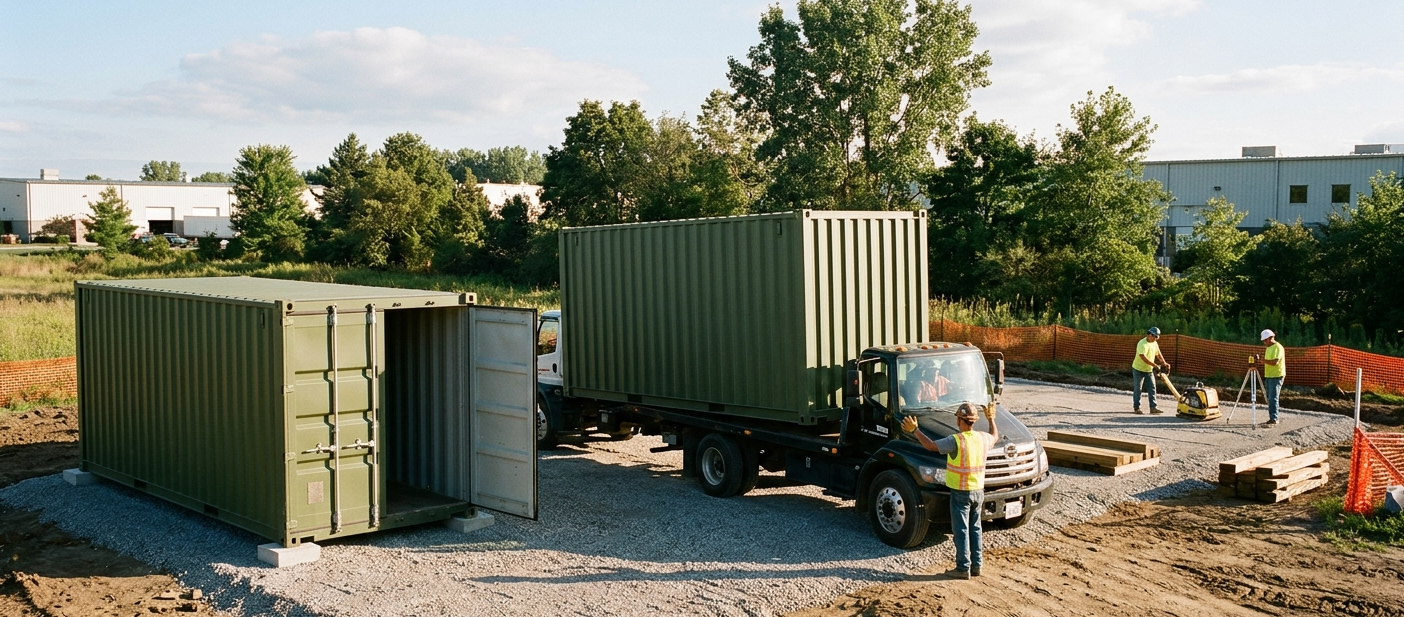
Tilt-bed trucks—and roll-off trailers—are the most common vehicles used for local rental drop-offs. With this method, the trailer bed is hydraulically raised into the air, tilting the back end downward. The driver then slowly drives forward, allowing the container to slide off the bed and land smoothly onto the ground.
-
The Major Benefit: No secondary equipment (like a crane or forklift) is needed to unload the container.
-
The Space Trade-off: Because the truck must drive out from underneath the container as it slides off, this method requires a massive amount of straight-line clearance in front of the final drop-off spot.
Flatbed Trucks
Flatbed trucks are typically used for long-distance shipping container transport or when multiple containers are delivered simultaneously. The trailer remains completely flat.
-
The Major Benefit: The truck itself does not need extra straight-line clearance to drive out from under the load.
-
The Space Trade-off: You must provide your own heavy machinery on-site—such as a crane, a heavy-duty forklift, or a rugged telehandler—to lift the container off the truck bed and place it on the ground. Because most temporary rental customers do not have this machinery on hand, tilt-bed trucks remain the standard choice.
Container Drop Off Requirements: Clearance and Space
Space miscalculations are the single most common cause of delivery day headaches. To avoid a costly “dry-run” fee (where the truck arrives but cannot physically drop off the container), verify that your site satisfies these strict spatial dimensions:
Straight-Line Clear Length
Because tilt-bed trucks must pull forward in a straight line while dropping the container, you need significantly more space than just the length of the box itself:
-
For a 20-Foot Container: You need at least 60 to 75 feet of straight-line clearance.
-
For a 40-Foot Container: You need at least 100 to 120 feet of straight-line clearance.
A good rule of thumb is to take the combined length of the truck and trailer, add the length of the container, and add an extra 10 to 15 feet of buffer space for driver maneuvering.
Width Clearance
The container itself is roughly 8 feet wide, but the delivery truck needs breathing room. Ensure the entry gates, driveways, and delivery paths have a minimum width clearance of 10 to 12 feet. Watch out for narrow alleyways, parked vehicles, construction debris, or tight turns that a long trailer cannot navigate.
Height Clearance
The truck and container sit high off the ground during transit, and the apex rises even higher when the tilt-bed is engaged. You must have a minimum overhead clearance of 14 feet along the entire travel path, and up to 20 feet of vertical clearance at the exact spot where the container is being dropped. Look up and clear out obstacles such as:
-
Low-hanging tree branches
-
Power lines and utility cables
-
Roof overhangs or gutters
-
Facility entry awnings
Comprehensive Site Preparation for Container Rental
Once you have verified that the delivery truck can physically reach your designated spot, it is time to focus on site preparation for container rental. Proper ground prep protects your property, protects the container, and ensures the structural integrity of your stored goods.
Evaluate the Ground Surface
The ideal surface for a Conex box is flat, hard, and stable.
-
Asphalt or Concrete: These are the best surfaces. They easily support the heavy weight without settling and require minimal prep beyond clearing the surface.
-
Gravel or Crushed Stone: An excellent alternative to concrete. Gravel provides fantastic drainage and a sturdy, compacted base that resists settling.
-
Dirt or Grass: While possible, grass and dirt present risks. If the ground gets wet or muddy, the container can sink into the earth. This causes uneven weight distribution, which can twist the frame and make the cargo doors impossible to open or close. If dropping on bare earth, compacting the soil beforehand is highly recommended.
Ensure Level Ground
A Conex box is a rigid steel Monocoque structure. If one corner sits lower than the others, the entire frame experiences a slight twist. When this happens, the locking bars won’t align correctly, and you will find yourself struggling to open or seal the heavy cargo doors.
Use a long bubble level or a laser level to check the grading of your site. If the ground has a slight slope, you will need to level the container using pressure-treated wood blocks (like 2×10 pads or 4×4 blocks) or concrete pavers placed under the corners to distribute the load evenly.
Plan for Moisture and Drainage
Never place a Conex box in a natural depression where rainwater pools. Standing water underneath the container accelerates rust on the undercarriage over time. Ensure the ground slopes away from the container site, or consider placing the container on top of wood blocks or gravel to elevate it slightly off the ground, promoting healthy airflow underneath.
What to Expect on Delivery Day
When delivery day finally arrives, being proactive can make the process smooth and quick, usually taking less than 30 minutes once the truck is in position.
Clear the Path Early: Move all employee vehicles, personal cars, equipment, and trash bins completely out of the delivery zone and turning radius.
Determine Door Orientation: Before the truck backs in, you must tell the driver which way you want the container doors to face. If you want the doors facing a specific building or fence, the container must be loaded onto the truck accordingly. Let your rental provider know your preference ahead of time so it is loaded correctly at the yard.
Designate an On-Site Contact: Ensure someone is physically present at the site to greet the driver, guide them into position, and sign any necessary delivery paperwork. The spotter can help watch for blind spots and overhead obstructions while the driver focuses on maneuvering the heavy rig.
Inspect and Test: As soon as the container is resting on the ground and before the driver leaves, test the doors. Open and close them completely. If they stick or feel misaligned, work with the driver to place shims or wooden blocks under the low corners until the doors operate effortlessly.
Trust Local Experts for Your Storage Needs
Renting a Conex box provides an immediate, secure solution to your storage challenges, provided you lay the groundwork for a successful drop-off. By verifying your straight-line clearances, ensuring a level foundation, and prepping the surface for proper drainage, you eliminate delivery day surprises and safeguard your assets.
At Elvis Service Company, we take pride in delivering top-tier portable storage solutions tailored specifically to our regional communities across South Carolina and North Carolina. From construction projects in Myrtle Beach to industrial logistics in Wilmington, our team understands the unique terrain and spatial demands of our coastal and inland neighborhoods. Contact us today to discuss your next container rental, and let our experienced transport professionals handle the heavy lifting safely and efficiently!
Sorry, the comment form is closed at this time.